
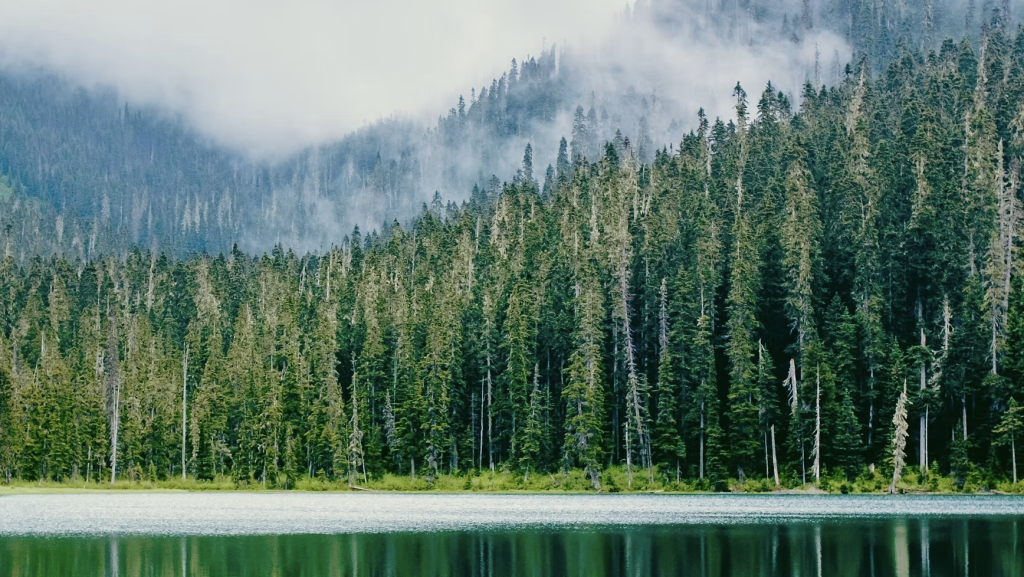
Gastronomy: Canadian Food in the 21st Century
Stratford Chefs School immerses our Apprentices in hands-on culinary training with Practical courses that build real-world culinary skills, but we also teach Theory courses such as Food History, Culinary Management, Communications, Nutrition, Gastronomy, and more. Exploring these multiple aspects of cuisine contributes to the development of skilled, well-rounded, thoughtful chefs.
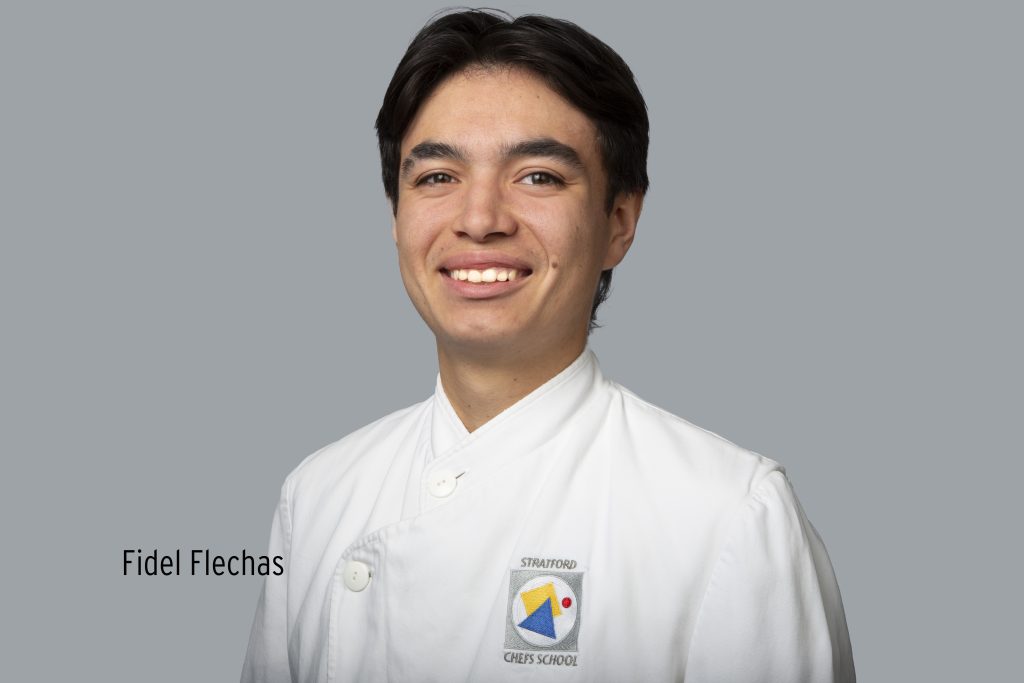
Critical issues facing our food systems, sustainability, and the roles food and cooking play in modern culture are examined in Level 2 Gastronomy, taught by Randi Rudner. When asked to reflect on the food world around them and investigate a current issue in Canadian food production of personal interest, a number of thought-provoking essays were submitted by our Level 2 Students. We are pleased to share with you the Gastronomy report by Fidel Flechas (Class of 2026) titled A Sentiment for the Salmon, The Watershed, and the Forests. We are thrilled to share his essay with you, with his permission.
'A Sentiment for the Salmon, The Watershed, and the Forests' | By Fidel Flechas
Heart Of The Raincoast
On May 13th, 2025, Billy Proctor, known as the “Heart of the Raincoast,” passed away (Graham, 2025). After 90 years, his legacy stands for passion, commitment, and curiosity. His knowledge brought together not just his own community, but all the coastal communities of British Columbia (Bradford et al., 2025). I first read "Heart Of The Raincoast: A Life Story” in 2016, but a second reading during quarantine in 2020 gave me a new perspective. Rather than offering an in-depth analysis or summary, I urge every Canadian to read it. Billy loved many things: hand-logging, commercial fishing, beach-combing, and collecting artifacts. He spent his life working in the inlets and archipelagos of the Canadian northwest, witnessing the collapse of salmon and herring runs, the disappearance of humpback whales, and the loss of old-growth forests (Smith, 2025). As he grew, so did his respect for the fish and the forest ecosystems. Over time, Billy realized his way of life was at risk as some fish faced extinction, so he chose to act. His years of lobbying, storytelling, and activism shaped and protected his home waters and forests, though there’s much more to do (Lelu Island Declaration, 2016).
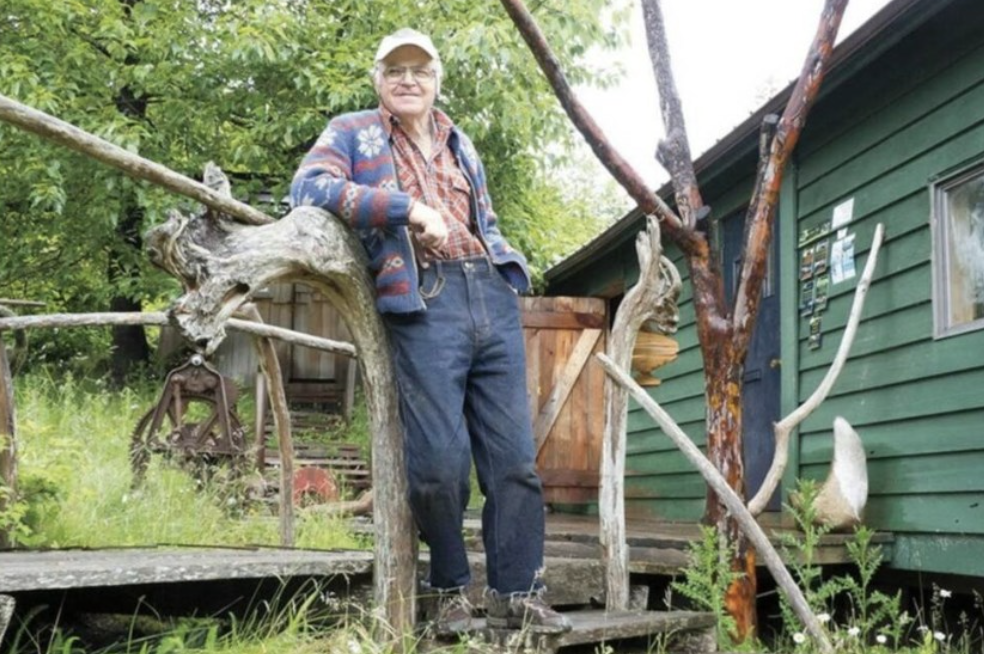
Photo: https://www.timescolonist.com/local-news/billy-proctor-heart-of-the-raincoast-dies-at-90-10678357
Forestry's Impact on Salmon
As a young chef raised on the West Coast and a summer tree planter, I am inspired by Billy’s purposeful life. Like him, I care deeply for cuisine and forests. Salmon, a staple at my table growing up, is integral to my identity as a cook. Tree planting brings fresh reasons each summer, though one remains: the hope that some trees last for centuries. In British Columbia, forestry and salmon are interdependent, ecologically, economically, and culturally. Pacific salmon runs are iconic, supporting Indigenous communities, the Canadian populace, tourism, and wildlife (Carnation Creek Watershed Experiment, 2022); but decades of logging and the destruction of old-growth forests have altered the watersheds central to salmon. Understanding forestry’s effects on salmon means looking at how forests, soils, and streams interact across the landscape. Research shows logging’s effects linger, worsening water quality, stream structure, and fish survival, for decades (Cunningham & Braun, 2023). Like Billy, I’ve influenced salmon and the watershed, but that motivates me to do more.
Water Temperature
One of the clearest ways forestry affects salmon is through water temperature. Forested riverbanks, or riparian zones, shade and cool the water, providing conditions essential for salmon to spawn. When these trees are removed, sunlight heats the water, increasing temperatures. Research from Simon Fraser University and Fisheries and Oceans Canada found that streams with logged riparian zones, especially where more than a third of the forest had been cleared, ran nearly four degrees warmer in summer than untouched streams. For salmon eggs and juveniles, even a slight temperature rise can mean the difference between thriving and surviving. Salmon, as ectotherms, match their body temperature to their environment. Warm water carries less oxygen and forces salmon’s bodies to work harder, increasing disease risk (Cunningham & Braun, 2023). Climate change compounds the problem, pushing temperatures higher and shrinking riparian zones. By the time young salmon begin their ocean journey, they encounter conditions that few generations before them faced (Cunningham & Braun, 2023).
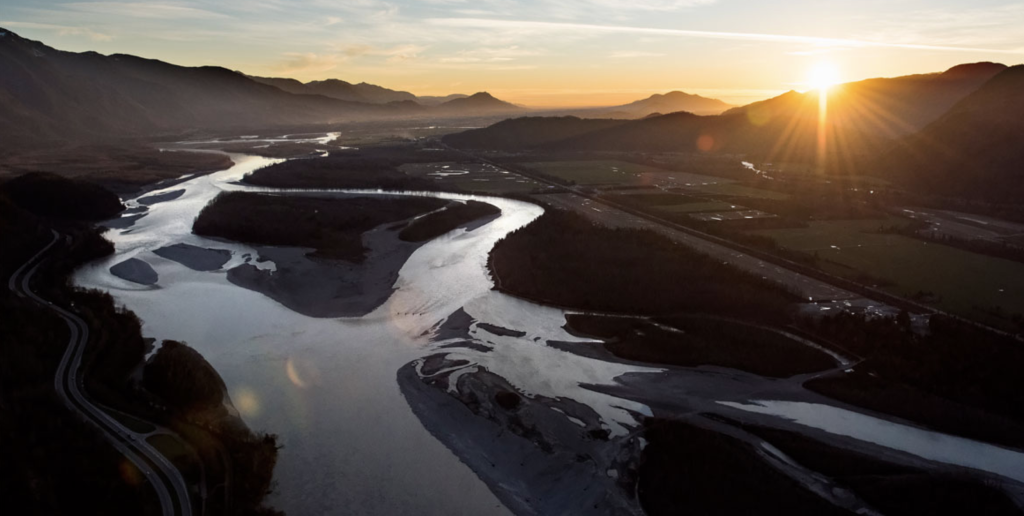
Photo: https://www.raincoast.org/2018/09/heart-of-the-fraser-ecological-stronghold-faces-imminent-threat/
Watershed Changes
Forestry’s influence, however, reaches far beyond temperature. Anyone who has spent time near timber operations has probably driven through an extensive web of roads which cut through steep valleys and remote hillsides. When these roads are poorly placed or maintained, the surrounding soils can destabilize and wash into nearby streams. For salmon, sediment isn't just murky water; it's an avalanche falling on their village. Salmon lay their eggs in gravel beds where clean water can circulate between the stones, but also create soft barriers. When fine sediment fills those spaces, oxygen flow drops and eggs struggle to hatch. Over time, heavy sediment deposits change the creek bottom, eliminating the deep pools where young fish shelter and grow (Greig et al., 2005, pp. 241-258).
Forestry–Fish Research
Fish–Forestry research across British Columbia has shown that these subtle changes in watershed structure, how water moves, how gravel settles, and how wood interacts with a stream, can shape the survival of salmon for generations (Tschaplinski et al., 2025). The research conducted at Carnation Creek on Vancouver Island highlights the various factors that affect stream health. Since 1970, scientists there have been observing what happens when forest harvesting intersects with salmon habitat. Carnation Creek has become one of the most important forestry–fish research sites in the world (Carnation Creek Watershed Experiment, 2022). In the early years after logging, the results were surprisingly mixed. With fewer trees shading the water, the creek warmed slightly, and some juvenile salmon actually grew faster; but time revealed a different story. Over the following decades, the physical impacts of logging began to reshape the stream itself. Banks eroded more quickly, sediment moved downstream in greater volumes, and the large fallen logs that once created shelter and complexity slowly disappeared. The channel gradually became simpler and less stable, and with it, the number of salmon surviving from fry to smolt declined. What Carnation Creek demonstrated most clearly is that the consequences of forestry rarely appear all at once. They unfold slowly, sometimes over decades, long after loggers have harvested (Ochman, 2010).
Multiple Impacts on B.C. Salmon
Of course, forestry is only one piece of a much larger puzzle. Salmon in British Columbia must now also face urban development, mining, climate change, shrinking snowpacks, and increasingly fragmented watersheds. A recent study in the journal FACETS points out how difficult it is to manage these overlapping impacts when regulations and policies treat each industry separately (Ulaski & Moore, 2025). Unlike corporate systems, ecosystems don’t divide themselves into neat categories. A river warmed by logging may also face lower flows due to climate change. Sediment from forestry roads can mix with runoff from agriculture or wildfires. Different problems build upon each other until the river reaches a point where salmon can no longer survive the combined strain. The footprint of forestry extends farther downstream into river estuaries. For example, estuaries along the Fraser, Columbia, and Skeena Rivers see juvenile salmon gather before entering the Pacific. Large bundles of floating timber known as log booms are often stored in estuaries before transport. Research published in the Canadian Journal of Forest Research found that areas surrounding these log booms supported far fewer benthic invertebrates, the small insects that juvenile salmon depend on (Effects of log booms on physical habitat, water quality, and benthic invertebrates in the lower Fraser River and estuary, 2024, pp. 918-931).
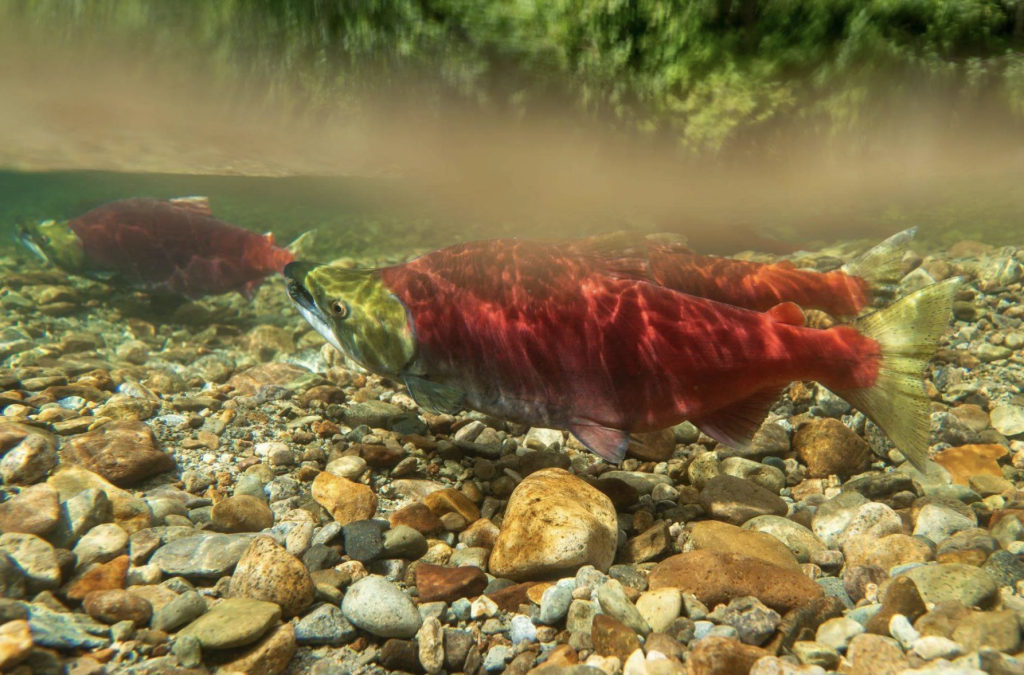
Photo: https://www.taramartin.org/2023/12/20/the-watershed-futures-initiative-collaborative-research-on-salmon-bearing-watersheds/
Shaping Better Stewardship
The effects of forestry are rarely confined to the forests themselves. They ripple outward, from headwater creeks to tidal areas. Yet despite a hydra of challenges, there is reason for optimism. Scientists and activists continue to explore our understanding of how forests and salmon are connected, and that knowledge is beginning to shape better stewardship. Initiatives like the “Watershed Futures Initiative (WFI)" led by Dr. Jonathan Moore and Dr. Nigel Sainsbury at Simon Fraser University are helping researchers examine cumulative impacts across entire ecosystems. Restoration projects are in the works, including the use of larger logs and trees, protection of riparian forests, and redesigning road systems to reduce erosion. Many of the most promising efforts are also being led in partnership with Indigenous communities, whose stewardship of salmon and forests stretches back thousands of years (Bradford et al., 2025).
Sustaining Salmon
For those who grew up on the West Coast, the fate of salmon isn't just a statistic in a report. It is part of a bigger story. Forestry shapes the watersheds these fish depend on, just as salmon have shaped the cultures and economies of this coast. The impacts of warmer streams, shifting sediments, and altered habitats are real and measurable; but forests grow back, and so can our relationship with the land. When I think about the trees I plant each summer, I wonder which ones will exist beyond my lifetime. Maybe centuries from now, their roots will hold a bank together, their branches will cool the water, and their fallen trunks will create rapids and carve deep pools. For young chefs like me, who care about the wild populations of Canadian flora and fauna, the salmon that appear on our menus represent far more than nutrition or a price point. They are a reflection of the forests, rivers, and choices that sustain them. I guess in those words, every salmon that returns is a reminder of what people like Billy Proctor spent their lives fighting for and why so many of us are trying, in our own ways, to follow in those footsteps.
About Fidel Flechas
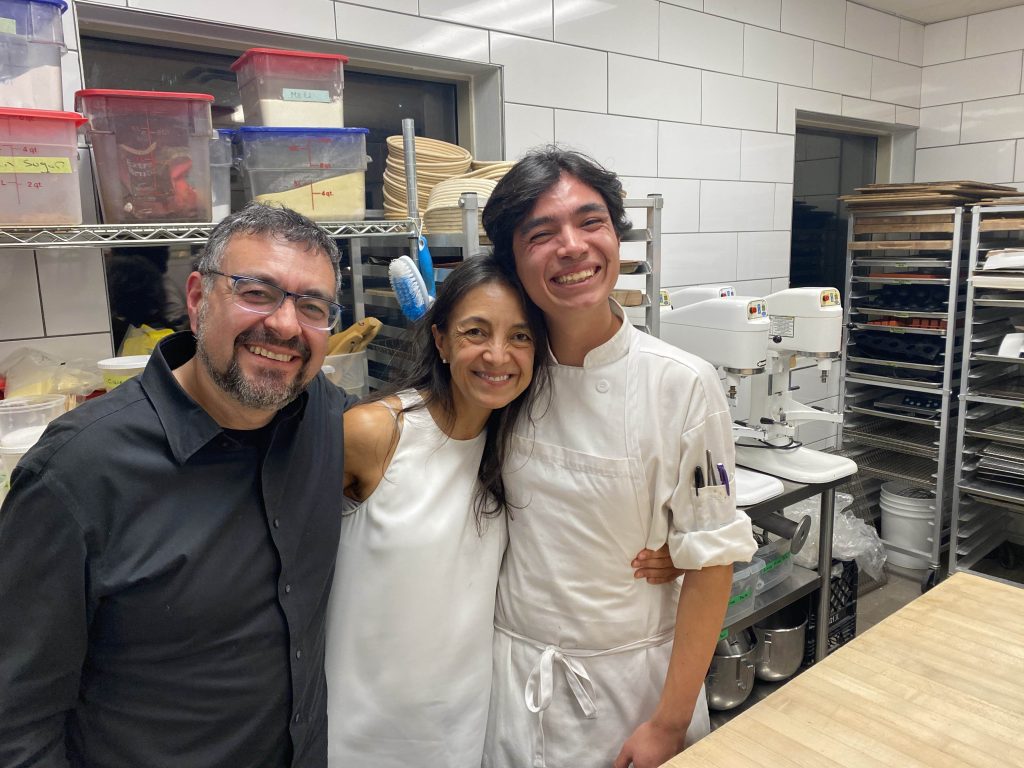
Fidel is the son of Colombian immigrants to Canada and has two siblings, an older sister and a younger brother. He grew up in Western Canada and has spent many summers tree planting in Northern B.C. In his application to Stratford Chefs School he wrote that he was unhappy at University, which he found was missing a kinetic component. He decided to pursue his passion for culinary and for creating art in different mediums, writing: "I love to cook; I love the heat of the kitchen, the focus, the art and most importantly, I love food. Growing up, I learned how to cook from my dad, who studied at the Dubrulle French Culinary School in Vancouver. Although my dad is an Architect, he has been fascinated with food since he was young and has instilled these beliefs in my siblings and me."
Congratulations on completing your Cook Apprenticeship Program, Fidel, your passion is contagious!
Bibliography
Graham, R. (May 14, 2025). Billy Proctor Passes at 90. Island Fisherman Magazine. https://islandfishermanmagazine.com/billy-proctor-passes-at-90/
Bradford, K., Wilson, K. B., Hodgson, E., Moore, J. W., Reid, A., Salomon, A., Minne, C. V., Armstrong, J., Alex, K., Benson, R., Dick, J. & Nicholas, G. (2025). Indigenous stream caretaking for Pacific salmon: ancestral lifeways to guide restoration, relationships, rights, and responsibilities. The Royal Society of Canada. https://doi.org/10.1139/voices-2025-0001
Smith, S. (October 1, 2025). Anglers delight in salmon returns, but SFU study warns of coho population collapse. Simon Fraser University. https://www.sfu.ca/sfunews/stories/2025/10/anglers-delight-in-salmon-returns--but-sfu-study-warns-of-coho-population-collapse.html
(2022). Carnation Creek Watershed Experiment. Province of British Columbia. https://www2.gov.bc.ca/gov/content/environment/plants-animals-ecosystems/fish/aquatic-habitat-management/fish-forestry/carnation-creek
Ochman, S. (2010). Impacts of Human Resource Extraction Activities on Natural Ecosystems. Watershed Sentinel. https://watershedsentinel.ca/articles/impacts-of-human-resource-extraction-activities-on-natural-ecosystems/
Ulaski, M. & Moore, J. (2025). Death by a thousand cuts: salmon falling through the cracks in B.C.’s fragmented policy landscape. FACETS. https://doi.org/10.1139/facets-2024-0348
(2024). Effects of log booms on physical habitat, water quality, and benthic invertebrates in the lower Fraser River and estuary. Canadian Journal of Forest Research 54(8), pp. 918-931. https://doi.org/10.1139/cjfr-2023-0163
Bradford, K., Wilson, K. B., Hodgson, E., Moore, J. W., Reid, A., Salomon, A., Minne, C. V., Armstrong, J., Alex, K., Benson, R., Dick, J. & Nicholas, G. (2025). Indigenous stream caretaking for Pacific salmon: ancestral lifeways to guide restoration, relationships, rights, and responsibilities. ScienceDirect. https://doi.org/10.1139/facets-2025-0042
Tschaplinski, P. J., Reid, D. A., Pike, R. G. & Spittlehouse, D. L. (2025). Long-term forestry and climate change effects on watershed processes and salmon populations at Carnation Creek, Vancouver Island, British Columbia. Frontiers in Ecology and Evolution 13. https://doi.org/10.3389/fevo.2025.1704400
Greig, S. M., Sear, D. A. & Carling, P. A. (2005). The impact of fine sediment accumulation on the survival of incubating salmon progeny: Implications for sediment management. Science of The Total Environment 344(13), pp. 241-258. https://doi.org/10.1016/j.scitotenv.2005.02.010
Cunningham, D. & Braun, D. (March 16, 2023). Historic logging contributes to water temperature increases for salmon, study finds. Simon Fraser University. https://www.sfu.ca/sfunews/stories/2023/03/historic-logging-contributes-to-water-temperature-increases-for-.html
Cunningham, D. & Braun, D. (March 16, 2023). Historic logging contributes to water temperature increases for salmon, study finds. Simon Fraser University News. https://www.sfu.ca/sfunews/stories/2023/03/historic-logging-contributes-to-water-temperature-increases-for-.html
(2016). Lelu Island Declaration. Wikipedia. https://en.wikipedia.org/wiki/Lelu_Island_Declaration
Learn More
Learn more about our Enriched Cook Apprenticeship 32 week program.
Learn more about our Open Kitchen recreational cooking classes and other events.
Do you have questions about our Program?
Contact us by email admin@stratfordchef.com or call 519.271.1414